

Introduction
Malaria remains a major public health challenge in sub-Saharan Africa, with increasing evidence showing that malaria vectors such as Anopheles gambiae and Anopheles funestus are adapting to outdoor biting behaviors. Conventional malaria prevention strategies, including Indoor Residual Spraying (IRS) and Insecticide-Treated Nets (ITNs), primarily target indoor mosquito transmission and are therefore less effective against outdoor exposure. In response to this challenge, CCEPO has, since 2022, implemented a research-based project aimed at developing and testing an innovative outdoor malaria vector control approach using ethnomedicinal, plant-based repellent oils. The intervention seeks to provide an environmentally friendly, affordable, and locally sustainable complementary malaria prevention strategy, particularly for populations engaged in the night-time economy.
Objectives
The study aimed to: (1) Develop and optimize formulations of mosquito repellents derived from plant extracts and shea butter; (2) Evaluate the efficacy of the developed mosquito repellent products; and (3) Advance the commercialization of effective mosquito repellent formulations.
Methodology
The study was implemented in two phases.
Phase 1: Pilot Study (18 Months)
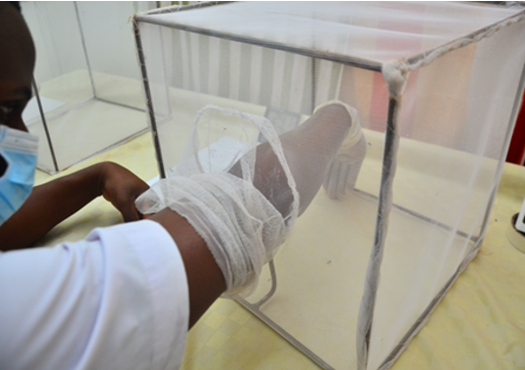
This phase focused on the development and preliminary testing of repellent prototypes. Entomological laboratory screening of selected plant oils was conducted using a five-point evaluation process informed by literature review. Eight promising plant oil samples were identified for formulation development and optimization. Arm-in-cage entomological tests involving 30 participants were conducted to assess protection efficacy, with the formulations demonstrating an average protection time of 8 ± 2 hours against mosquito bites.
Phase 2: Semi-Field Randomized Controlled Trial
A semi-field randomized controlled trial was conducted at Gudie Leisure Farm in Wakiso District. Participants were randomized into two groups: (1) Intervention arm (n = 40): Participants applied the plant-based repellent lotion to all exposed skin surfaces. (2) Control arm (n = 40): Participants applied a placebo lotion to exposed skin surfaces.
All participants received malaria prophylaxis and slept under Long-Lasting Insecticidal Nets (LLINs) throughout the study period. The primary outcome measure was the duration of protection against mosquito bites. Two study sessions were conducted during the rainy and dry seasons, each lasting five days.
Expected Outcomes
The study is expected to generate evidence on the efficacy and feasibility of ethnomedicinal plant-based mosquito repellents as an outdoor malaria vector control strategy. Successful formulations may contribute to reducing outdoor malaria transmission among vulnerable populations engaged in nighttime economic activities while supporting the development of scalable and locally sustainable vector control innovations.